
Take Me Home (2022)
I travelled to Azerbaijan in April of 2022 and lived there for four months in order to meet other artists, explore, paint, and put on an art exhibition with them. The exhibition was titled “Məni Evinə Apar” (“Take Me Home”), inspired by the Azerbaijani custom of hospitality towards foreigners.
I collaborated with eight artists from different regions of Azerbaijan. I travelled with each artist to their homeland in order to learn more about them and where they came from. We then both created a work of art in response to our trip.
The final exhibition featured eight artworks created by the Azerbaijani artists, shown alongside eight corresponding artworks created by me. I painted the scene from each trip that impacted me the most, and tried to infuse the paintings with what I learned from each artist and the experience we had together.
The show ran from July 2 to 8 at the National Museum of History of Azerbaijan. Please visit the “Take Me Home” Facebook and Instagram pages.
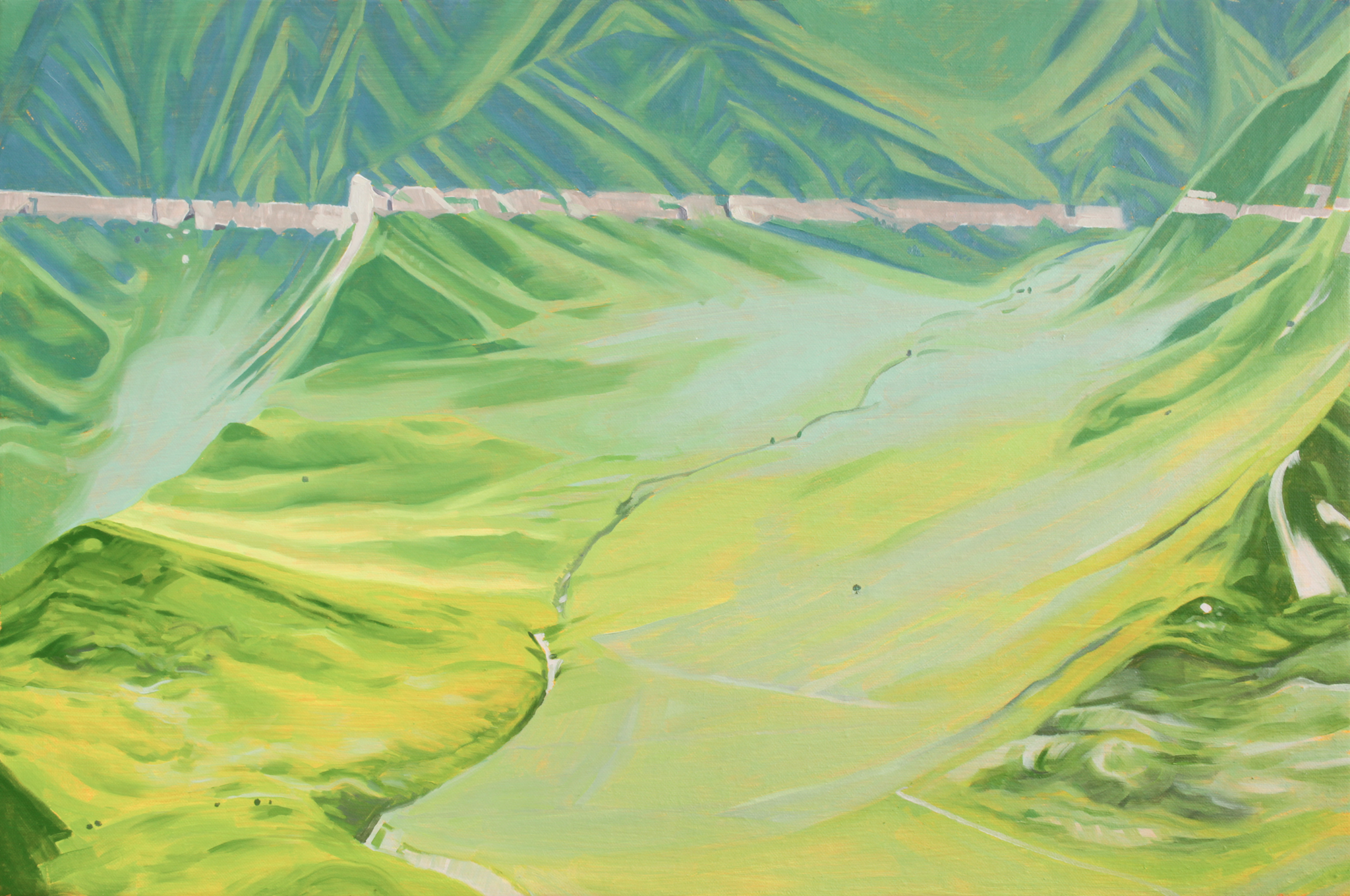
40 x 60 cm.
Buy Original
The foothills near Laza, which seem to be draped in green velvet. The richness and fertility of these mountains pours down on you, and this plenitude was reflected in the overwhelming hospitality I received on my trip to Qusar. The landscape is depicted without sky or foreground. The soft, undulating mountainside takes up the entire field of view, so that the observer might feel they could reach out and touch it.
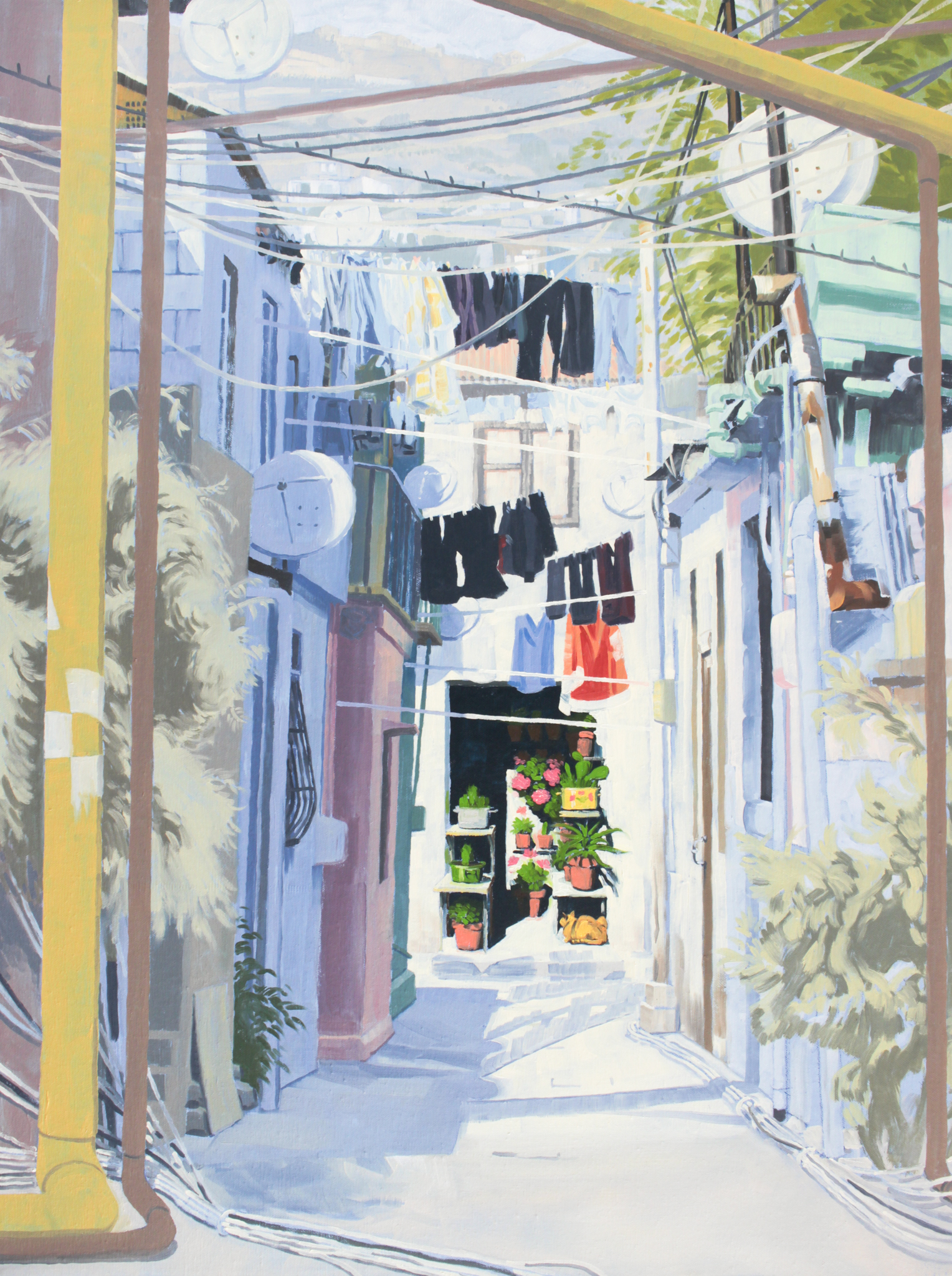
80 x 60 cm.
Buy Original
An imagined view from the heart of Bayil, composed of both the outer and inner layers of the neighborhood. Finding a house here feels like delving into a labyrinth. Each turn into a narrow side street obscures more of the sky and brings you to places hidden away from the cliff-top villas hanging overhead, to where people take care of the simple daily tasks that make life more dignified. The focal scene of lively plants, a cat, and hanging clothes draws the gaze inward using unrealistic perspective and a shift in contrast and vibrancy, giving a sense of being hemmed in, and of warm invitation.
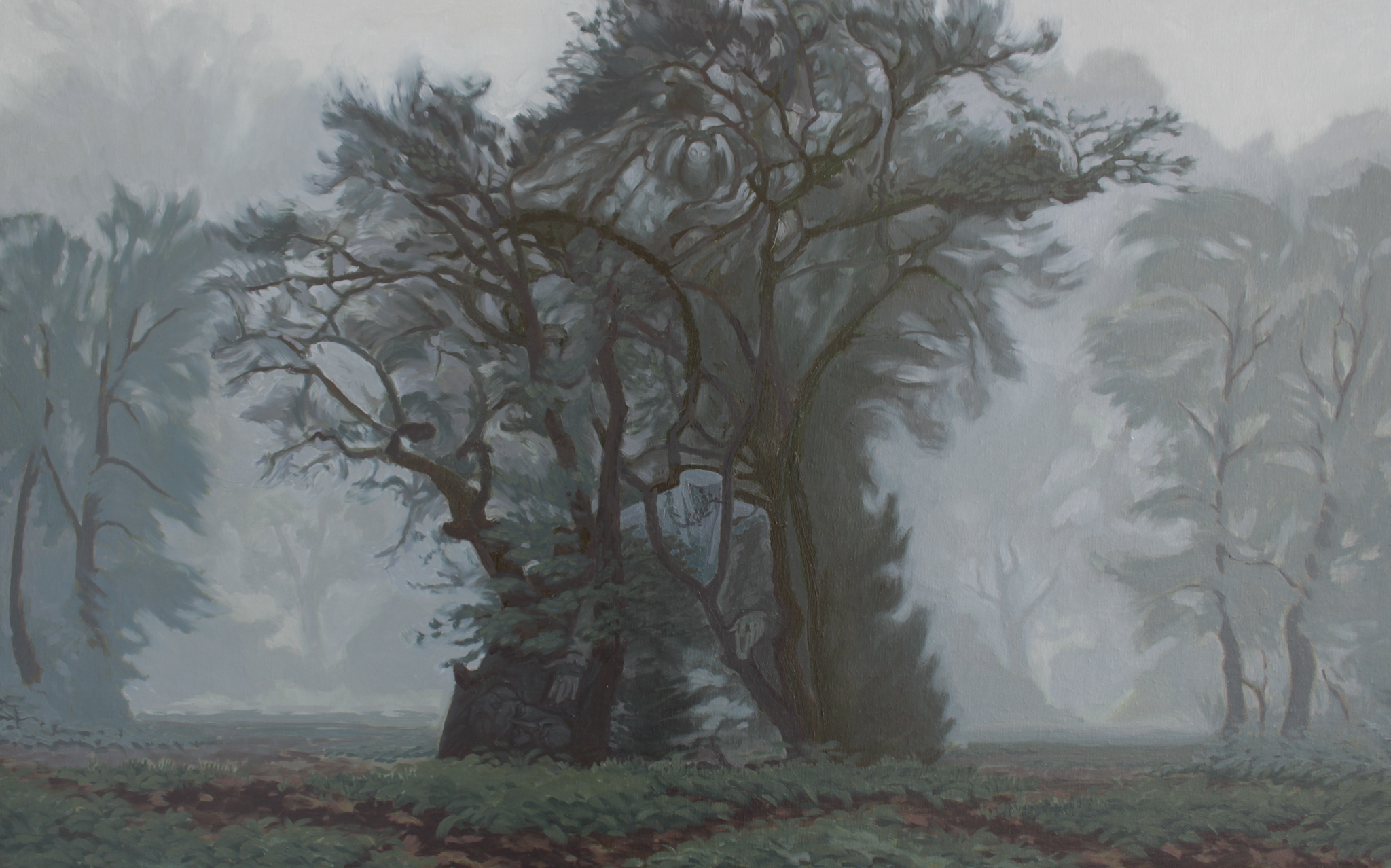
50 x 80 cm.
Buy Original
The woods near Goygol, filled with dense fog. Many people in the former border areas around Ganja still live in a war-time state of fear and uncertainty. A resident of a nearby village chased away our prying cameras, while Goygol hid itself in a cloud, away from our gaze. I learned how a desperate man once tried to kill the corrupt former mayor of Ganja, stories of Nizami’s head being stolen by the Russians, and of the current flight of creatives and intellectuals away from Ganja. The negative spaces in the branches carve out the sinister forms of predatory animals and headless poets.
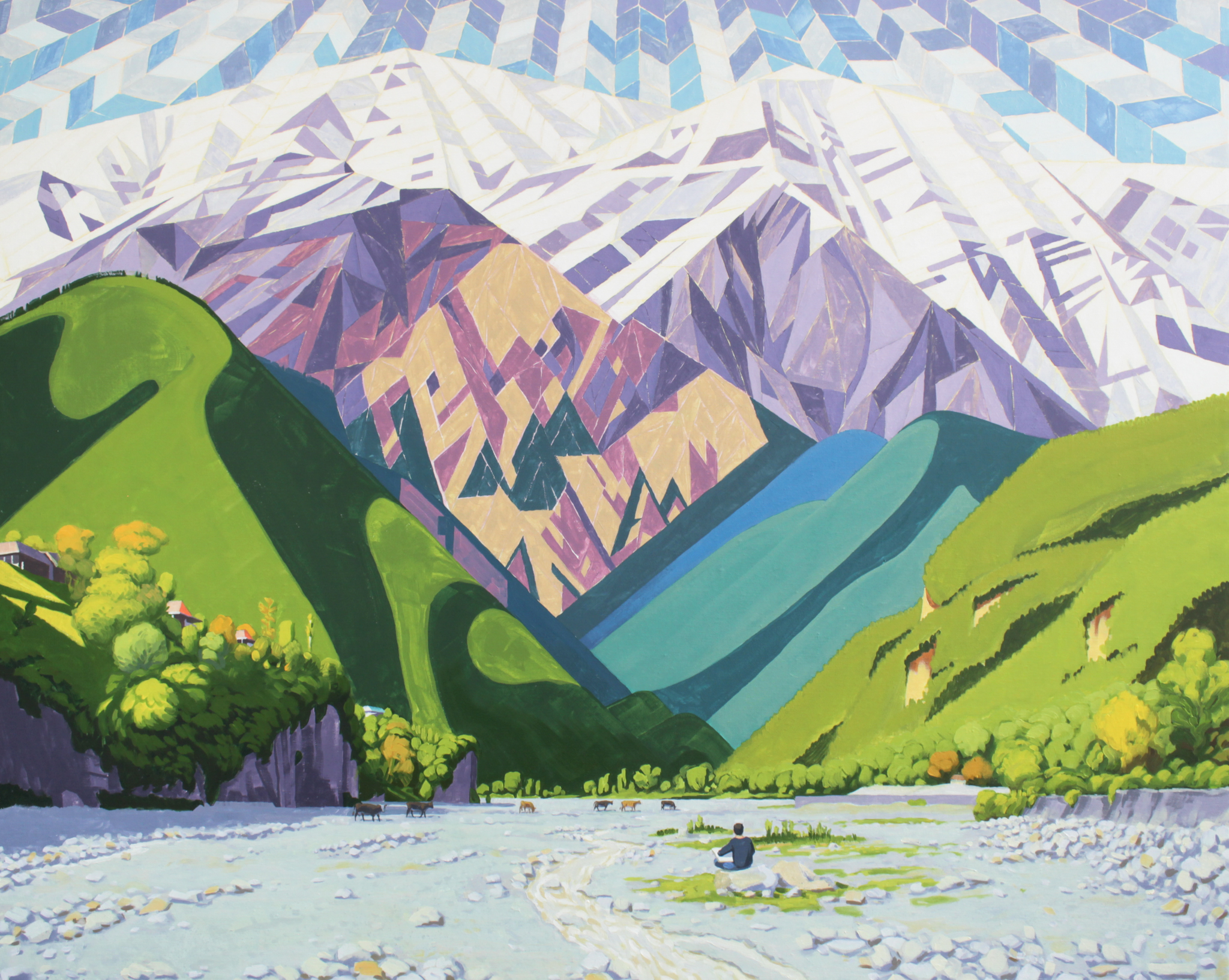
80 x 100 cm.
Buy Original
The icy peaks of the Greater Caucasus looming over a river notorious for flash floods. For now the Kish River is just a trickle, allowing cows to wander through the gully, and an artist to take advantage of the view. The mountains are patterned like the geometric mirrors found in the Palace of Sheki Khans, in order to relate the power of the mountains (which can wash away the town) to the power of the Khan (who can sever the hands of the artist who decorated his palace). This artist reminds me of Tural (@moyufov), who struggled to become an artist against the opinions of family and society, and of the Titan Prometheus, who was exiled in these mountains. The cows walking between the artist and the mountain refer to Tural’s grandmother, who supported his dreams by selling milk and cheese.
30 x 50 cm.
Buy Original
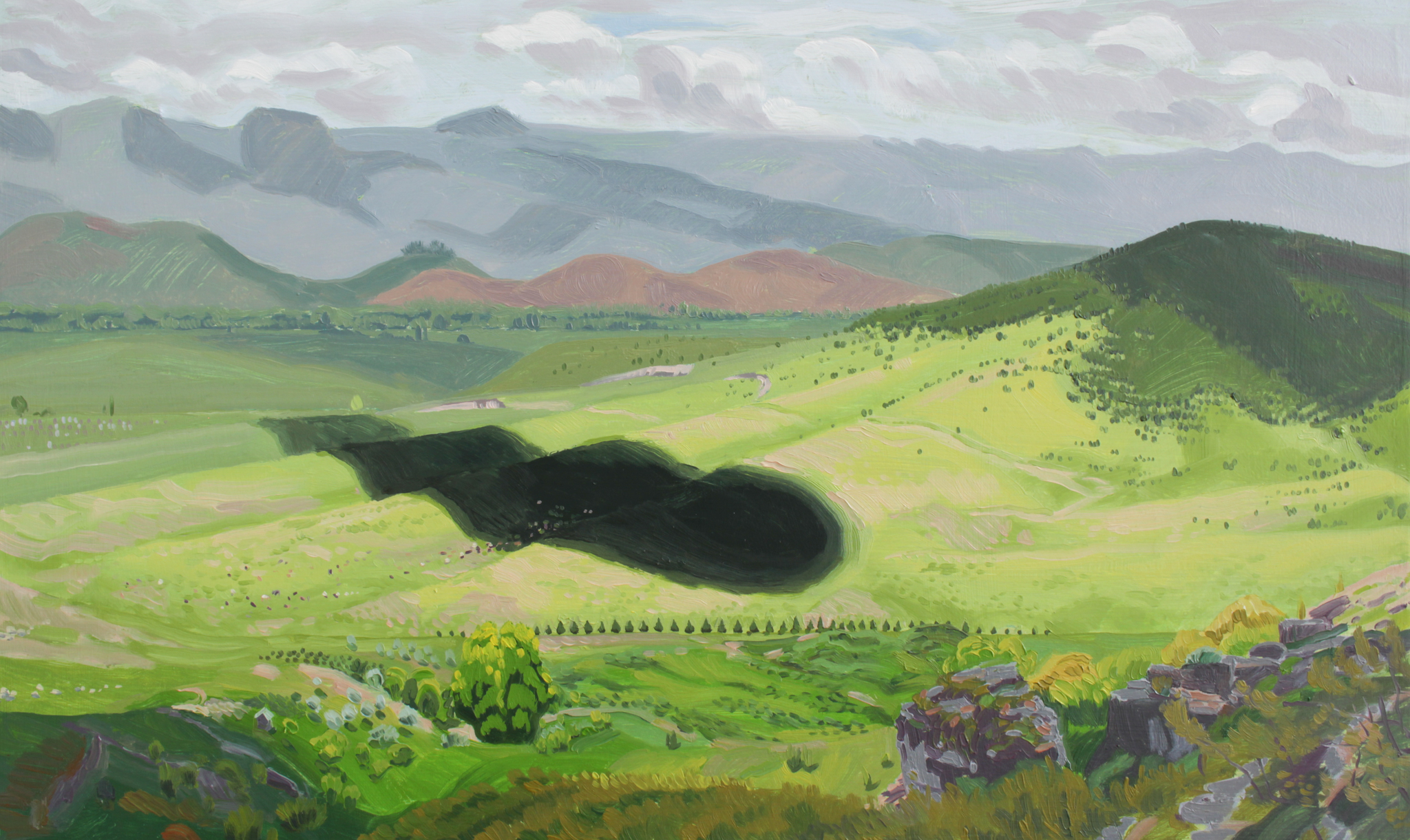
Sunlit foothills and fields where animals graze, punctuated by a hole-like shadow gliding across the surface. Caves and holes were repeated motifs during my trip to Agstafa, and I use them to represent the lingering social and infrastructural problems found in this otherwise peaceful, pastoral paradise.
40 x 70 cm.
Buy Original
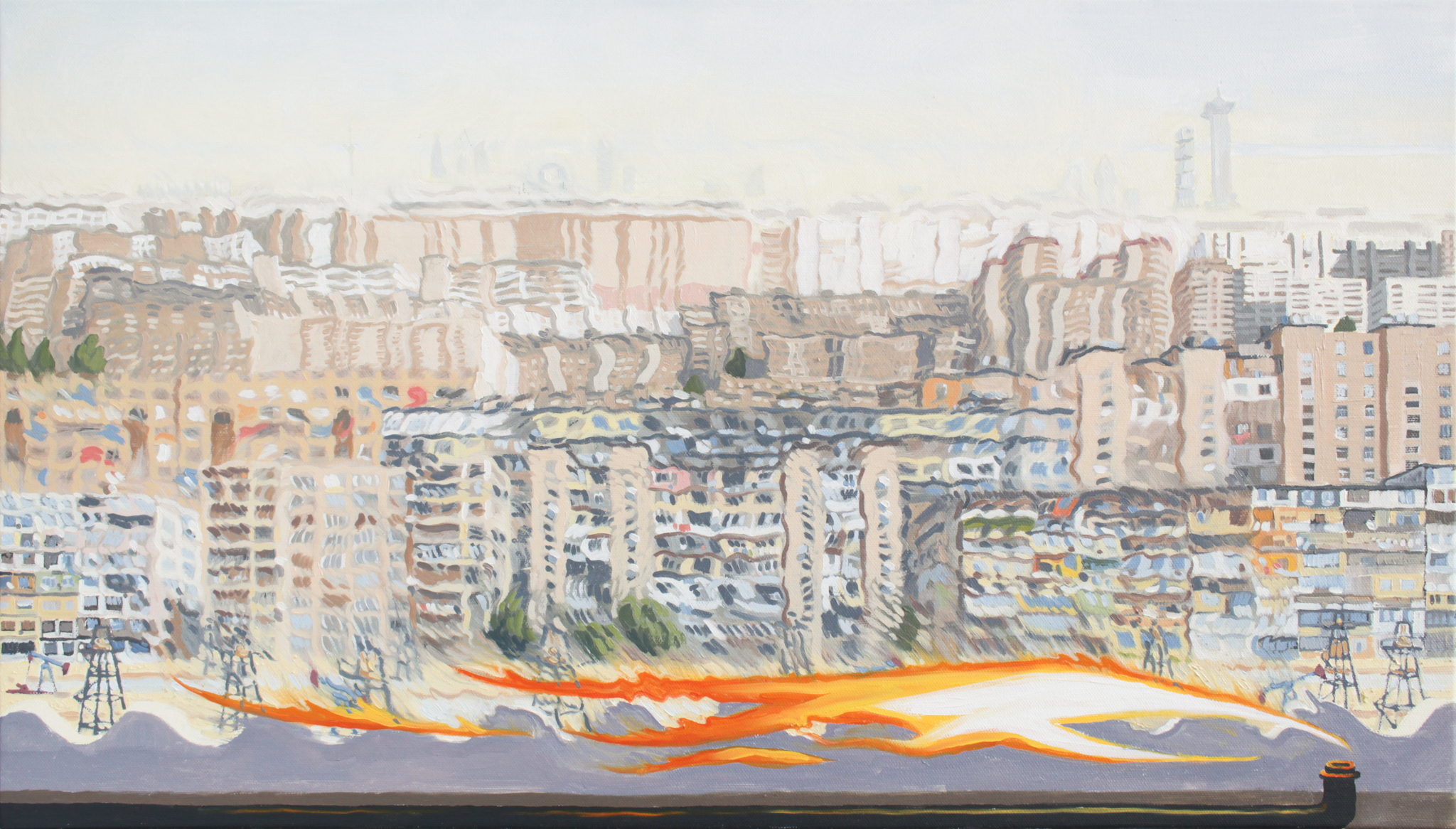
The Soviet apartment blocks, natural gas flares, and bold modern architecture of Baku seen through the heat distortion of the ‘eternal flame’ of the Ateshgah. Baku is only possible because of the resources that fed those sacred fires, yet most Azerbaijanis don’t feel they benefit from the oil and gas industry. The city is depicted as both an ancient premonition come to life and a mirage.
49 x 76 cm.
Buy Original
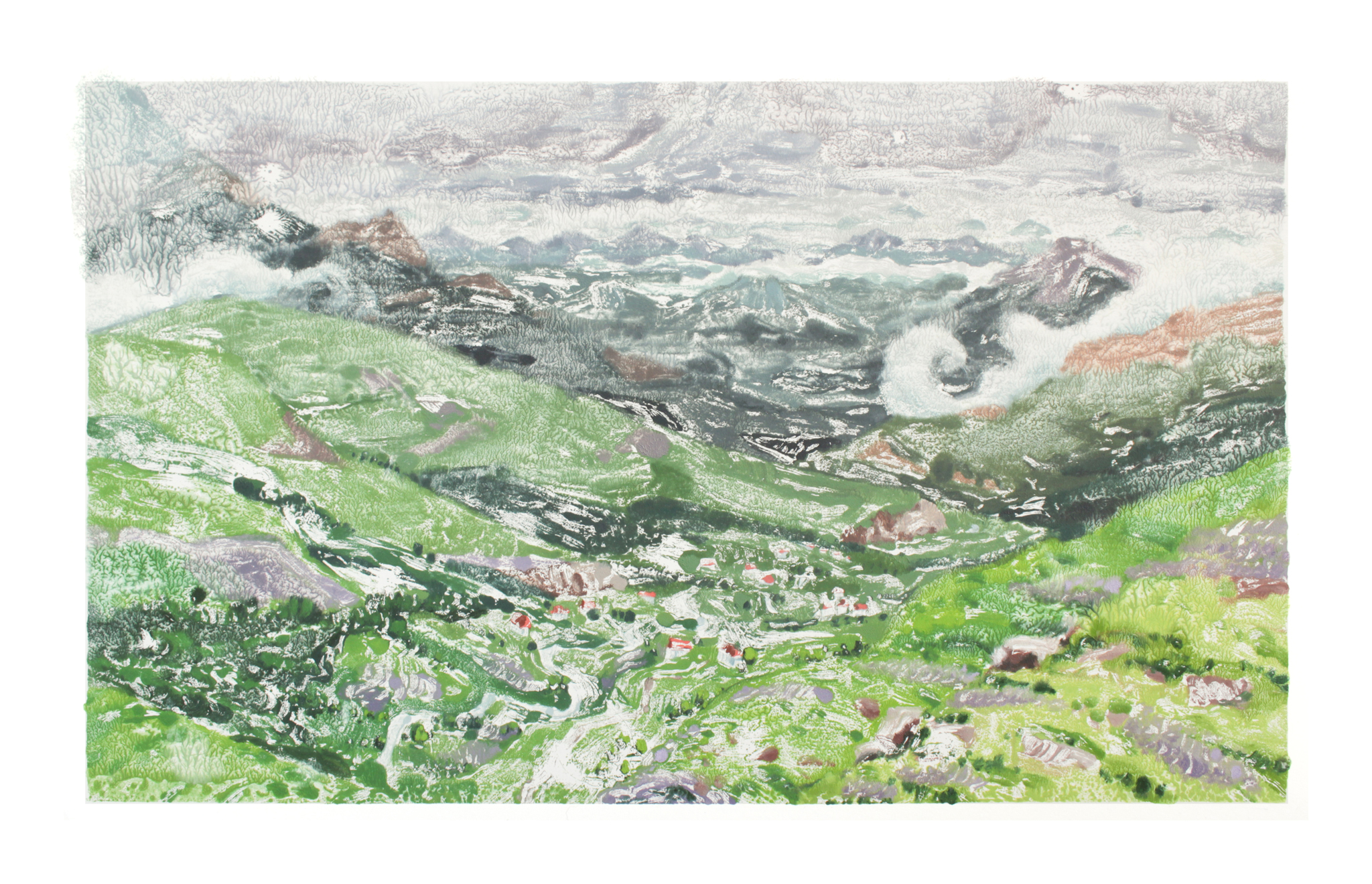
A Lachin-like landscape of rolling green hills, silvery mountains, and red rooftops. Due to the presence of landmines, I could not travel to Lachin with Yusif Mirza. Instead, I learned about Lachin through his stories, paintings, and photos. The monotype technique turns the landscape into a ghostly impression, like my vague mental image of the place.
80 x 160 cm.
Buy Original
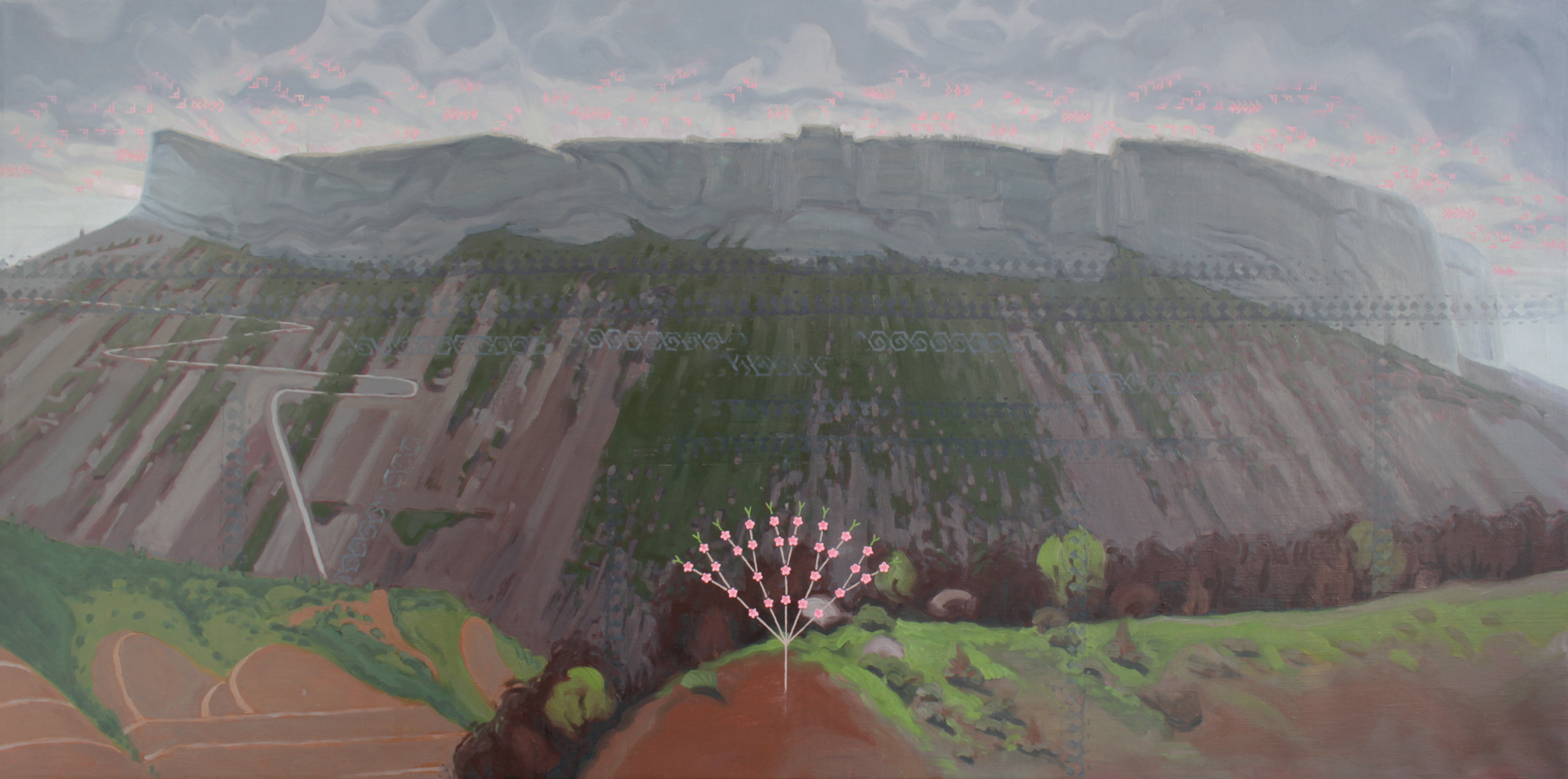
The cliffs of Shusha as seen from the new Victory Road. At this time, Shusha was still inaccessible to most people due to both security restrictions and its inherent nature as a fortress city built on a mountain. The carpet ornaments act as symbols, telling the story of my experience there and things that Ramiz Abbasov shared with me about his home. The fences of “mullah basha” evoke borders, protection, and obstruction. Fractured running water (axan su) ornaments refer to mineral springs that have run dry. Bird ornaments trace a hopeful song in the sky, and the tree of life takes the form of a cherry blossom tree with a flower for each year that Shusha’s residents have been unable to return home.